1904 United States Gubernatorial Elections
| 1904 United States Gubernatorial Elections | ||
|---|---|---|
| ←1903 | November 8th, 1904 | 1905→ |
|
Republican Seats before — 27 Seats won — 20 Seats after — 24 Seats change — ↓3 |
||
|
Democratic Seats before — 17 Seats won — 13 Seats after — 20 Seats change — 3 |
||
|
Silver Seats before — 1 Seats won — 0 Seats after — 1 Seats change — 0 |
||
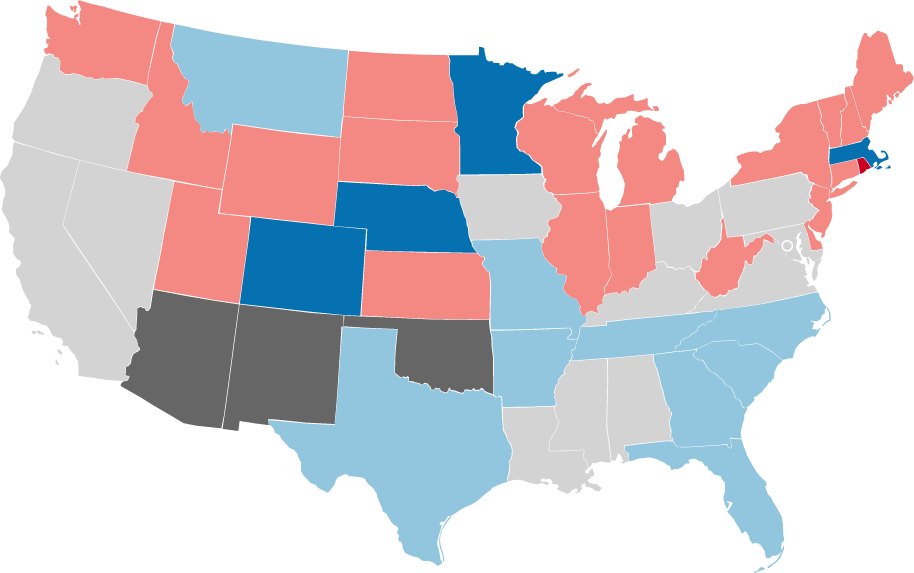
Democratic gain Democratic hold
Republican gain Republican hold |
||
United States gubernatorial elections were held in 1904, in 33 states, concurrent with the House, Senate, and presidential elections, on November 8, 1904 (except in Arkansas, Georgia, Maine and Vermont, which held early elections).
In Wyoming, a special election was held following the death of Governor DeForest Richards in April 1903.
The elections took place concurrently with the 1904 presidential election, elections to the House of Representatives and Senate, and numerous state and local elections.
Pre-election Composition
Going into the election, there were 27 Republican governors, 17 Democratic governors, and one governor belonging to the Silver Party.
Results
| State | Incumbent | Party | Result | Opposing Candidates |
|---|---|---|---|---|
| Arkansas (held September 5th, 1904) | Jefferson Davis | Democratic | Democratic hold | Harry H. Myers (Republican) John G. Adams (Prohibition) |
| Colorado | James H. Peabody | Republican | Democratic gain |  Alva Adams (Democratic) Alva Adams (Democratic)Robert A. N. Wilson (Prohibition) Andrew H. Floaten (Socialist) James Merwin (People's) J. A. Knight (Socialist Labor) |
| Connecticut | Abiram Chamberlain | Republican | Incumbent retired, Republican hold | Henry Roberts (Republican) A. Heaton Richardson (Democratic) George A. Sweetland (Socialist) Oliver G. Beard (Prohibition) Timothy Sullivan (Socialist Labor) Joseph Sheldon (Populist) |
| Delaware | John Hunn | Republican | Incumbent retired, Republican hold | Preston Lea (Republican) Caleb S. Pennewill (Democratic) Joseph H. Chandler (Independent Republican) John R. Price (Prohibition) Gustave E. Reinicke (Socialist) |
| Florida | William Sherman Jennings | Democratic | Incumbent term-limited, Democratic hold | Napoleon Bonaparte Broward (Democratic) Matthew B. MacFarlane (Republican) W. R. Healey (Socialist) |
| Georgia (held October 5th, 1904) | Joseph M. Terell | Democratic | Democratic hold | Unopposed |
| Idaho | John T. Morrison | Republican | Incumbent lost re-nomination, Republican hold | Frank R. Gooding (Republican) Henry Heitfeld (Democratic) Theodore B. Shaw (Socialist) Edwin R. Headley (Prohibition) T. W. Bartley (People's) |
| Illinois | Richard Yates Jr. | Republican | Incumbent lost re-nomination, Republican hold | Charles Samuel Deneen (Republican) Lawrence B. Stringer (Democratic) John Collins (Socialist) Robert H. Patton (Prohibition) Philip Veal (Socialist Labor) James Hogan (People's) Andrew G. Specht (Continental) |
| Indiana | Winfield T. Durbin | Republican | Incumbent term-limited, Republican hold | James Frank Hanly (Republican) John Worth Kern (Democratic) Felix T. McWhirter (Prohibition) Matthew Hallenberger (Socialist) Leroy Templeton (People's) E. J. Dillon (Socialist Labor) |
| Kansas | Willis J. Bailey | Republican | Incumbent retired, Republican hold | Edward W. Hoch (Republican) David M. Dale (Democratic) Granville Lowther (Socialist) James Kerr (Prohibition) |
| Maine | John Fremont Hill | Republican | Incumbent retired, Republican hold | William T. Cobb (Republican) Cyrus W. Davis (Democratic) Nathan F. Woodbury (Prohibition) Wilbur G. Hapgood (Socialist) |
| Massachussetts | John L. Bates | Republican | Democratic gain | William L. Douglas (Democratic) John Quincy Adams (Socialist) Oliver W. Cobb (Prohibition) Michael T. Berry (Socialist Labor) |
| Michigan | Aaron T. Bliss | Republican | Incumbent retired, Republican hold | Fred M. Warner (Republican) Woodbridge N. Ferris (Democratic) James M. Shackleton (Prohibition) Clayton J. Lamb (Socialist) Meiko Meyer (Socialist Labor) |
| Minnesota | Samuel R. Van Sant | Republican | Incumbent retired, Democratic gain | John Albert Johnson (Democratic) Robert C. Dunn (Republican) Charles W. Dorsett (Prohibition) Jay E. Nash (Public Ownership) A. W. M. Anderson (Socialist Labor) |
| Missouri | Alexander Monroe Dockery | Democratic | Incumbent term-limited, Democratic hold | Joseph W. Folk (Democratic) Cyrus P. Walbridge (Republican) Ernest T. Behrens (Socialist) Orange J. Hill (Prohibition) William C. Alldredge (People's) J. E. White (Socialist Labor) |
| Montana | Joseph K. Toole | Democratic | Democratic hold | William Lindsay (Republican) Malcolm G. O'Malley (Socialist) |
| Nebraska | John H. Mickey | Republican | Democratic gain | George W. Berge (Democratic/Populist) Clarence F. Swander (Prohibition) Benjamin H. Vail (Socialist) |
Colorado Controversy
In Colorado, Democratic candidate Alva Adams won the vote by a narrow margin, but the incumbent Republican James H. Peabody contested the results. The following investigation found evidence of blatant and egregious corruption on behalf of both parties.
With the entire governance of the state having ground to a halt two months after assuming office, Adams resigned, with Peabody sworn in as his replacement. Having previously agreed to concede the election, he likewise resigned, allowing lieutenant governor Jesse MacDonald to be sworn into office – thus earning Colorado the distinction of being only state to have three different governors on the same day.